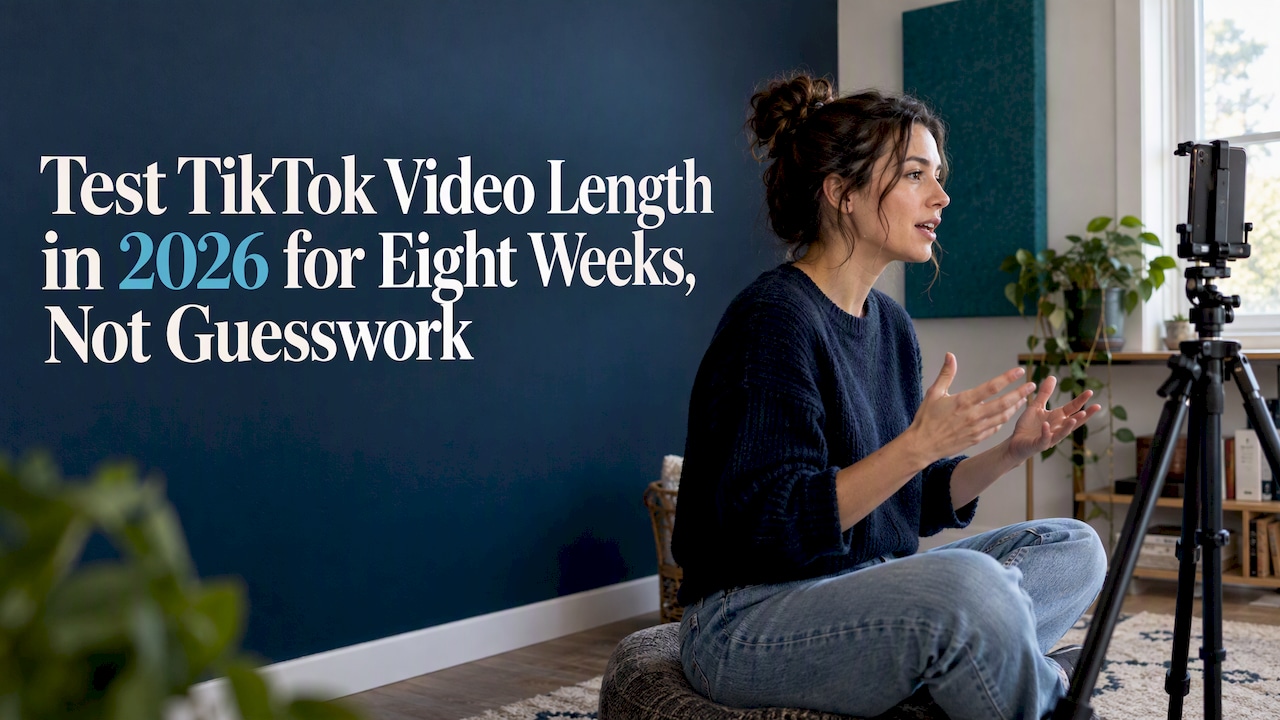
For most creators in 2026, the sweet spot for a TikTok video is 20 to 45 seconds, long enough to deliver one clear idea, short enough to hold full-watch attention. Longer formats between 3 and 10 minutes still earn views for tutorials and interviews. We built this guide around current platform data and hands-on workflow testing.
TL;DR:
- Native recording typically tops out around 10 minutes, while some reports put edited uploads at 60 minutes; limits vary by app version and device.
- Clips under 15 seconds tend to earn stronger completion, while 60 to 90 second tutorials hold attention only when pacing stays tight.
- Use 20 to 45 seconds for awareness demos, 60 to 90 seconds for trust building testimonials, and five minutes or more for full walkthroughs.
- Test length over eight weeks: establish a baseline, compare shorter and longer versions of the same theme, then scale using completion and rewatch rates.
Table of Contents
- TikTok’s Upload Limits and the Specs That Affect Long Videos
- What 2026 Data Shows About Average TikTok Video Length
- Length Targets by Content Type and Goal
- How to Choose the Right Length for Your Brand
- Editing and Formatting for Your Target Length
- Testing Length Like a Workflow, Not a Guess
- What We’d Prioritize Going Into 2026
- Put the Test Plan to Work With the Right Tools
- FAQ
- Sources
TikTok’s Upload Limits and the Specs That Affect Long Videos
TikTok treats in-app recording and direct uploads differently, and that distinction matters more than most creators realize. Native recording inside the app commonly caps out around 10 minutes, while uploaded files can run considerably longer, with some reports citing limits as high as 60 minutes for uploaded content, according to platform documentation and 2026 analysis. If you are recording directly in-app, plan your content to fit that 10-minute ceiling. If you are editing elsewhere and uploading the finished file, you have more room, but more room does not mean more watch time.
A few technical factors decide whether a longer video even makes it onto the platform cleanly:
- File size limits vary by app version and device, so a heavily compressed long file sometimes uploads faster and cleaner than a lightly compressed one.
- Codec compatibility (H.264 is the safest bet) reduces the chance of a failed upload or forced re-encode that strips quality.
- Older app versions sometimes block uploads above certain durations, so keeping the app updated avoids avoidable friction.
Aspect ratio still matters as much as duration. Vertical full-screen video at 1080×1920 (9:16) remains the format TikTok rewards, because it fills the screen on mobile and keeps viewers from scrolling past in the first frame.
What 2026 Data Shows About Average TikTok Video Length
The numbers back up the shorter-is-usually-better instinct, but not as absolutely as some creators assume. Several 2026 analyses converge on a median video length in the 30 to 45 second range, with one widely cited dataset putting the headline figure at 41 seconds.
Median TikTok video length in 2026 sits around 41 seconds, according to aggregated 2026 platform analysis, a figure that lines up with what we have seen across the accounts we track for tool testing. That median is not an accident. It reflects a mix of short hook-driven content and slightly longer explainer clips, averaged across millions of uploads.
Completion and replay behavior cluster around specific bands rather than spreading evenly:
- Clips under 15 seconds tend to post the highest completion rates, since viewers rarely abandon something that short.
- Videos in the 20 to 45 second range show strong replay behavior when the content rewards a second watch, like a quick tip or a punchline.
- Longer educational content (60 to 90 seconds) holds attention well when every cut earns its place, but drop-off accelerates past the one-minute mark if pacing sags.
None of this means short always wins. A well-structured 6-minute tutorial can outperform a rushed 20-second version of the same idea, because the value delivered matches the time asked for. The caveat that matters most: both very short and considerably longer posts can succeed, but only when the length matches what the content is actually trying to do. A hook with nothing behind it fails at 15 seconds just as easily as a padded explainer fails at 5 minutes.
Length Targets by Content Type and Goal
Rather than chasing one universal number, match your runtime to what the video needs to accomplish. Based on 2026 platform guidance and our own testing across different content types, here is how the ranges break down:
- Very short hooks (6 to 18 seconds): built for trend participation, quick reactions, and pure discovery plays where the first frame has to do all the work.
- Discovery sweet spot (20 to 45 seconds): the default for most brand and creator content, long enough for a setup and payoff, short enough to avoid drop-off.
- Deep short-form (30 to 90 seconds): suited to tutorials, step-by-step tips, and any content where the value needs a beat or two to land.
- Long-form (3 to 10+ minutes): reserved for interviews, in-depth breakdowns, and content you want viewers to settle in for rather than scroll past.
Each range works for mechanical reasons, not just habit. Shorter clips lean on curiosity and immediate payoff, which is why they post higher completion rates. Mid-length content benefits from rewatch behavior, viewers replaying a tip they missed the first time. Long-form content works when it signals clear value upfront, because TikTok’s algorithm still needs early watch-time signals to decide whether to keep pushing it.
Pro Tip: Take your best-performing long-form video and cut three 15-second teaser clips from its strongest moments. Post them across a week to drive traffic back to the full video instead of hoping the algorithm surfaces it on length alone.
Our guide to turning long videos into shorts walks through the tools that make this repurposing step fast rather than tedious.
How to Choose the Right Length for Your Brand
Picking a length is not a style preference, it is a decision with inputs you can actually define. We use a three-step framework when planning a posting schedule:
- Start with the goal. Awareness content favors shorter, high-completion clips. Consideration and conversion content can justify longer runtimes if the payoff is clear.
- Match the audience’s attention archetype. A scroll-heavy, discovery-driven audience rewards short hooks, while a subscribed, intent-driven audience will sit through a longer explainer.
- Find the minimum viable runtime. Ask how little time it takes to deliver the actual value, then edit ruthlessly to that number instead of padding toward a round figure.
Before you shoot, run through a short checklist:
- What is the single goal of this video, awareness, education, or a direct action?
- Where will it be distributed, TikTok only or repurposed elsewhere?
- What is the call to action, and does it need setup time to land?
- How will you measure success, completion rate, saves, or click-throughs?
A quick product demo built for awareness fits the 20 to 45 second band. A client testimonial meant to build trust for a service business often needs 60 to 90 seconds to feel credible. A full walkthrough meant to replace a sales call can justify 5 minutes or more.
Editing and Formatting for Your Target Length
Once you know your target runtime, the edit decides whether you actually hit it. Start with the cut that matters most: the first 1 to 3 seconds. If the opening frame does not promise something specific, trim it, because that is where most drop-off happens regardless of total length.
A few editing habits keep runtime tight without losing substance:
- Use jump cuts to remove dead air between thoughts rather than relying on one continuous take.
- Trim pauses and filler words aggressively in talking-head content, where every second of silence costs attention.
- Speed up visual b-roll sections slightly, but preserve natural pacing in spoken segments so speech clarity does not suffer.
Captions are not optional at any length. On-screen text improves accessibility and keeps sound-off viewers engaged, and it doubles as a discoverability signal since TikTok reads caption text for search relevance.
Export settings matter just as much as the cut. Stick with 1080×1920 resolution, H.264 encoding, and a bitrate high enough to survive TikTok’s compression without visible artifacts. Our aspect ratio and export checklist covers the specific settings that avoid the soft, blocky look that kills watch time on mobile.
Pro Tip: Export a test clip at your intended final settings and watch it on your phone over mobile data, not Wi-Fi, before publishing. Compression artifacts that are invisible on a desktop monitor often show up clearly on a phone screen at TikTok’s actual delivery bitrate.
Testing Length Like a Workflow, Not a Guess

We treat length decisions the same way we treat every tool test: hands-on, measured, and specific to the use case rather than generic advice. The metrics that actually tell you whether a length is working are completion rate, average watch time, rewatch rate, and conversion on whatever action you are driving toward.
Here is an 8-week structure we recommend for creators and marketers who want a real answer instead of a hunch:
- Weeks 1 to 2: post your current default length consistently to establish a baseline across completion and watch time.
- Weeks 3 to 4: introduce one shorter variant (within the 20 to 45 second band) on the same content theme, keeping thumbnail and caption style constant.
- Weeks 5 to 6: introduce one longer variant (60 to 90 seconds or longer) on the same theme, again holding other variables steady.
- Weeks 7 to 8: compare results and scale whichever length band shows the clearest lift in completion and rewatch rate.
| Week range | Focus | Primary metric |
|---|---|---|
| 1 to 2 | Baseline length | Completion rate |
| 3 to 4 | Shorter variant | Average watch time |
| 5 to 6 | Longer variant | Rewatch rate |
| 7 to 8 | Compare and scale | Conversion |
A full 8-week test plan for short-form trends breaks down each phase with more detail on variant control and measurement thresholds.
What We’d Prioritize Going Into 2026
If we had to narrow this down to two decisions, we would optimize the first 3 seconds of every video before anything else, and we would build a habit of cutting short discovery clips from every long-form piece we publish. Those two moves compound: a strong hook earns the watch time that tells the algorithm to push further, and discovery clips feed new viewers into longer content that would otherwise sit unseen.
Beyond that, the biggest gap we see is discipline. Creators test length once, call it settled, and move on. The accounts that actually improve run the comparison deliberately, track the same metrics every time, and give a format a few weeks before judging it.
— H
Put the Test Plan to Work With the Right Tools
Running an 8-week length test is only as useful as the tools that make each variant fast to produce. There are curated Best AI Tools For TikTok Videos lists aimed at helping creators chop, caption, and reformat content across multiple runtimes efficiently.
If you need to generate multiple length variants quickly from a single script, OpenVidi supports multi-length outputs that fit different test bands without a full reshoot. For faster iteration across formats, Take4K offers upfront pricing on each asset, which helps when testing several versions in one week.
- Start with our tested tool directory to find an editor that matches your current workflow.
- Use the 8-week plan to structure your next testing cycle instead of guessing at length.
- Revisit your export settings before you scale whichever length wins.
FAQ
Is a 4-minute video too long for TikTok?
A 4-minute video is not too long for TikTok and fits comfortably within the platform’s recording and upload limits. Whether it performs well depends on whether the content justifies that runtime, a detailed tutorial or interview can hold attention at 4 minutes, while a simple tip is usually better served by a shorter cut in the 20 to 45 second range.
What is the recommended post length for TikTok in 2026?
Most 2026 guidance points to a 20 to 45 second range as the default sweet spot for discovery and retention, with the median length sitting around 41 seconds across aggregated platform data. Tutorials and step-by-step content often extend to 30 to 90 seconds, while in-depth formats like interviews can run 3 to 10 minutes or longer.
Can TikTok videos be longer than 10 minutes?
Yes, uploaded files (as opposed to videos recorded directly in the app) can exceed 10 minutes, with some reports citing upload limits as high as 60 minutes, according to platform data. Native in-app recording typically caps around 10 minutes, so longer content generally needs to be edited elsewhere and uploaded as a finished file.
Can I post a 5-minute video on TikTok?
Yes, a 5-minute video is well within TikTok’s upload limits and works for formats like tutorials, interviews, or detailed breakdowns. For discovery purposes, pairing a long upload with a short teaser clip in the 20 to 45 second range often helps drive viewers to the full video.