YouTube ranks Shorts by viewer performance and personalization, not by hashtags or a fixed hook length. Metadata still matters, but it wins search relevance, not attention. Focus on five measurable signals: who chooses to watch, average view duration, average percentage viewed, likes and saves, and post-watch survey results.
TL;DR:
- Creator-focused metadata such as titles and descriptions influence discovery, but viewer retention determines algorithmic ranking and ongoing distribution.
- Video length should match content needs; padding to an arbitrary duration harms completion rates and overall Shorts performance.
- On-screen text and spoken keywords reinforce topic relevance, but auto-captions need correction for niche or technical terms to improve indexing.
- Thumbnails only affect search and channel placements; for Shorts, in-feed autoplay minimizes their importance unless used in search results.
- Consistent testing of variables like hooks, pacing, and scheduling over multiple uploads reveals what genuinely improves performance, rather than chasing trending tactics or viral cues.
Table of Contents
- What YouTube Officially Says About Shorts Ranking
- Metadata and Publishing Best Practices for Shorts
- Retention and Replayability: Hooks, Pacing, and Structure
- Multimodal Signals: Text, Speech, and Audio
- Thumbnails and CTR Testing for Shorts
- Channel-Level Strategies: Playlists, Series, and Session Continuation
- Analytics and the Comparative Testing Workflow
- Practical Tools and Scaled Workflows
- Timing and Frequency Recommendations for Shorts
- Cross-Promotion Tactics to Boost Shorts Visibility
- Understanding the Shorts Shelf and Its Impact on SEO
- Author Perspective: What Actually Moves the Needle
- TechVideoBlog as an Optional Next Step
- Sources
- FAQ
What YouTube Officially Says About Shorts Ranking
YouTube’s own guidance is clearer than most creators realize, and it contradicts a lot of the advice circulating in 2026. The platform states plainly that Shorts are ranked by performance and personalization, and there is no format YouTube favors over another. A Short does not get a ranking boost just for being a Short.
That single sentence undercuts a huge chunk of “algorithm hack” content. There is no fixed three-second hook rule. There is no magic completion percentage. There is no required duration cutoff where a 22-second video suddenly outperforms a 31-second one. YouTube has repeatedly clarified through its Shorts monetization guidance that it does not publish universal thresholds for hook timing or ideal length, which means any creator selling you a rigid formula is guessing.
Here’s what YouTube actually names as measurable signals:
- Viewer choice: whether someone taps to watch when the Short appears in their feed or search results
- Average view duration: raw time spent watching, not just a percentage
- Average percentage viewed: how much of the Short a typical viewer completes
- Likes and saves: explicit signals that a viewer valued what they watched
- Post-watch survey results: direct feedback YouTube collects on Short quality
Pro Tip: Stop asking “how do I beat the algorithm” and start asking “would a stranger scrolling at 11 p.m. choose to watch this over the next ten options?” That reframing, which YouTube’s own discovery guidance essentially encodes, changes what you script and edit.
The practical takeaway: metadata gets your Short in front of the right person, but performance decides whether YouTube keeps showing it to more people. Optimize for both, but never confuse one for the other.
Metadata and Publishing Best Practices for Shorts
Titles, descriptions, captions, and tags do not move the algorithm the way retention does, but they determine whether the right viewer sees your Short in the first place. Search relevance is a discovery filter, not a ranking multiplier. Get metadata wrong and even a great Short underperforms because it never reaches its intended audience.
Here is the sequence that works:
- Write the title like a search query, not a caption. Put your primary keyword near the front, phrased the way a person would actually type it. “How to Fix a Loose Doorknob” beats “Doorknob Fix Tips!!” because it matches search intent directly.
- Use the description to add context search can’t get from video alone. Two or three sentences explaining what the Short covers, plus a link to a related long-form video, helps YouTube connect the dots between your short-form and long-form catalog.
- Say your keyword phrase out loud in the first few seconds. YouTube SEO guidance consistently points to on-camera keywords as a contextual signal that reinforces your written metadata, especially when captions capture the same phrase.
- Upload accurate captions instead of relying only on auto-generated ones. Auto-captions are fine for accessibility, but a curated caption file lets you correct misheard keywords and keep your target phrase intact.
- Use hashtags sparingly, as labels rather than levers. YouTube is explicit that hashtags cannot compensate for weak retention or a mismatch with viewer intent. Two or three relevant tags beat a wall of ten generic ones.
- Fill in Studio tags to capture secondary phrasing. Tags are lower priority than title and description, but they catch alternate search terms a viewer might use, and you can test their effect through Studio’s traffic reports.
The biggest mistake creators make here is treating metadata as a substitute for content quality. A perfectly optimized title on a Short with a weak first three seconds still gets swiped past. Metadata gets you the click; the edit gets you the watch.
One more thing worth stating directly: keyword research for Shorts is not the same exercise as keyword research for long-form video. Short-form queries tend to be shorter, more conversational, and more likely to be typed mid-scroll (“quick pasta hack,” “why is my plant dying”) than deliberately searched. Build your title language around how people phrase quick questions, not how they’d search a full tutorial.
Retention and Replayability: Hooks, Pacing, and Structure
Retention is the single biggest lever in Shorts SEO because average percentage viewed feeds directly into how often YouTube shows your Short to new viewers. Everything else, including perfect metadata, is secondary to whether people actually stay.
The first half-second matters more than any scripted “hook line.” A visual change, an unexpected object in frame, or motion that breaks the pattern of whatever the viewer just swiped away from earns the initial choice to watch. From there, the goal shifts to keeping that choice validated frame by frame.
A few structural patterns consistently outperform generic talking-head Shorts:
- The promise-then-payoff structure: state what the viewer will get in the first line, then deliver it faster than expected.
- Loopable edits: end the Short on a frame that flows naturally back into the opening, which encourages an unconscious rewatch.
- Micro cliffhangers: withhold one small piece of information (a number, a result, a name) until the final seconds.
- Pacing shifts: a sudden slow-motion moment or a jump cut mid-Short resets viewer attention exactly when interest tends to dip.
Length is more flexible than most advice suggests. A tutorial that genuinely needs 45 seconds to make sense should take 45 seconds. A joke that lands in eight seconds should end at eight seconds. The mistake is padding a Short to hit an arbitrary “ideal” length instead of matching duration to the actual content goal. YouTube’s guidance on performance-based ranking rewards completion rate over runtime, so a tight 15-second Short with 90% average view completion beats a stretched 40-second one that loses half its audience by the midpoint.
Pro Tip: If you’re not sure whether your Short is too long, cut the last five seconds and watch it back. If nothing important is lost, it was too long.
Your first frame and first audio cue also function as a filter in the Shorts feed itself. A blurry thumbnail-frame or dead air at the start reads as low effort in a fraction of a second, and viewers swipe before your actual content even begins.
Multimodal Signals: Text, Speech, and Audio
YouTube reads a Short through more than one channel at once, and each one carries its own weight. On-screen text, spoken words, and audio choice combine into a contextual layer that reinforces (or undercuts) your written metadata.
On-screen text works best when it’s sparse and timed to match speech rather than dumped as a wall of captions:
- Keep contrast high; white text with a dark outline reads on almost any background.
- Time text to appear with the spoken word, not a beat before or after.
- Include your target phrase in on-screen text at least once if it fits naturally.
- Avoid stacking more than one text element on screen simultaneously.
Auto-generated captions are good enough for basic accessibility, but they frequently mishear brand names, technical terms, and niche vocabulary. If your keyword phrase is unusual or industry-specific, upload a corrected caption file so the exact phrase appears in the transcript YouTube indexes.
Saying your keyword out loud does double duty: it reinforces the topic for viewers and gives YouTube a spoken-language signal to match against search queries, an approach YouTube SEO best practices consistently recommend over stuffing text alone.

Trending audio is a distribution tool, not a search tool, and mixing up those two purposes backfires. A trending sound can widen your reach in the Shorts feed, but if it doesn’t match your Short’s actual intent, you often get views without the qualified outcomes, subscribers, clicks, comments, that make those views useful.
Thumbnails and CTR Testing for Shorts
Thumbnails matter for Shorts in a narrower set of places than most creators assume. Inside the vertical Shorts feed, viewers see the video itself autoplaying, not a static thumbnail, so thumbnail design has zero influence there. Where it does matter is anywhere a Short appears as a search result or inside a channel grid, both spots where a static image competes for the click.
For those search-listed placements, a simple checklist keeps thumbnails effective:
- Feature one clear subject. A cluttered thumbnail loses to a single readable focal point at small sizes.
- Use minimal text, if any. Two or three words at most; Shorts thumbnails render small, and long text blurs into noise.
- Match the thumbnail to what actually happens at the start of the video. A mismatched thumbnail spikes clicks but tanks average percentage viewed, which then hurts future distribution.
If you want to know whether a thumbnail change actually helps, run a controlled comparison instead of guessing. Swap the thumbnail only on Shorts that already rank in search results, leave everything else identical, and track CTR alongside average percentage viewed for two to three weeks. A thumbnail that lifts CTR but drops retention is not a win. It is a mismatch you just paid for in wasted impressions.
Channel-Level Strategies: Playlists, Series, and Session Continuation
Individual Shorts compete for individual views, but a channel that organizes its Shorts into a coherent structure gets rewarded with something more valuable: session continuation. When a viewer finishes one Short and YouTube has an obvious next-play candidate from the same creator, that session tends to extend, and extended sessions signal topical authority.
A few structural habits build this over time:
- Group related Shorts into a playlist with a consistent, searchable naming pattern instead of scattering them under one-off titles.
- Cross-link Shorts to relevant long-form videos in the description; this tells YouTube the two pieces of content share a topic, which reinforces cluster depth.
- Use consistent phrasing across a series (“Part 1: [Topic],” “Part 2: [Topic]”) so viewers and the algorithm both recognize the pattern.
None of this risks your long-form channel’s performance. YouTube’s discovery guidance confirms Shorts performance doesn’t drag down long-form recommendations, so testing a series structure carries little downside as long as each piece still delivers on its own promise.
Analytics and the Comparative Testing Workflow
Guessing at what moved a Short’s performance wastes more time than running an actual test. YouTube Studio breaks down where views come from, Shorts feed, Search, Suggested, and External, and that breakdown should dictate what you fix next, not a generic checklist.
Here’s the loop:
- Diagnose the traffic source first. If most views come from the Shorts feed and drop off fast, your problem is retention, not metadata. If Search traffic is thin, your title and description need work regardless of how strong your edit is.
- Form a hypothesis and change exactly one variable. Swap the hook, adjust the title, or test a new caption style, never all three at once.
- Upload a control batch first, then the variant, keeping topic and format otherwise identical.
- Measure viewer choice, average percentage viewed, replays, and subscriber conversions across both batches.
- Decide based on the numbers, not on gut feel or one viral outlier.
Studio’s own analytics guidance frames this exact approach, comparative testing across similar-format uploads, as more useful than chasing whatever went viral once. A single breakout Short tells you almost nothing repeatable; a pattern across five or six controlled uploads tells you what actually works for your channel.
Once you’ve run a few loops, pull your search-term report and group the queries into content clusters. If three different search phrases all point to the same underlying question, that’s your next Short topic, already validated by real viewer language instead of a guess.
Practical Tools and Scaled Workflows
Producing enough Shorts to run a real testing loop means production speed matters as much as strategy. A handful of tool categories cover most of the workflow: auto-captioning tools for fast, accurate transcripts; on-screen text overlay tools for consistent styling across a batch; short-form editors built specifically for vertical formats; repurposing tools that pull clips from long-form video; and thumbnail assistants for the search-listed placements where thumbnails count.
A reasonable single-Short workflow looks like this: draft the script around a validated search phrase, generate a rough cut with an AI-assisted short-form editor, run captions through an auto-captioning tool, then do a human pass to fix any misheard keywords and tighten the first three seconds by hand. AI speeds up the repetitive parts; a person still needs to check the hook and the pacing before publishing.
Testing of these categories is done from a creator’s practical perspective, focusing on actual use rather than marketing claims. Reviews consider ease of use, output quality, and pricing transparency, aiming to identify tools that effectively save creators time. If you’re building out a Shorts production pipeline, the YouTube Shorts tool category breaks down which tools handle which part of that workflow, and the tested AI tools roundup covers hands-on comparisons across editors, captioning, and repurposing options.
Timing and Frequency Recommendations for Shorts
There is no officially published “best time” to upload Shorts, and any specific hour-by-hour chart you see is a generalization from someone’s individual channel data, not a YouTube rule. What matters more than clock time is consistency and volume relative to your testing plan.
Publish on a schedule you can actually sustain, three times a week beats seven if seven means rushed edits and weak hooks. Frequency should serve your comparative testing loop: you need enough uploads in a short window to compare variables meaningfully, which usually means at least two to three Shorts per week during an active test period.
Spacing also matters for diagnosis. Uploading five Shorts in one day makes it hard to isolate which one is driving a spike in subscribers or a dip in average percentage viewed. Spread test variants across separate days so Studio’s traffic-source data stays cleanly attributable to a single upload.
If your audience skews toward a particular time zone or viewing habit, check your existing Audience tab for when your subscribers are already online, then anchor your upload schedule around that window rather than a generic “post at noon” rule copied from a blog. The consistency of the schedule matters more than the specific hour you choose.
Cross-Promotion Tactics to Boost Shorts Visibility
Shorts don’t have to rely on YouTube’s algorithm alone to find their first wave of viewers. Sharing a Short’s link on Instagram, TikTok, X, or a community Discord can seed early watch time that helps YouTube’s own systems evaluate the content faster.
A few tactics work better than a blanket “share everywhere” approach. Repurpose the same vertical clip across platforms where it fits the native format, since a Short built for YouTube already matches the aspect ratio most other short-form platforms expect. Embed the Short in a blog post or newsletter where it adds genuine context rather than feeling bolted on. Pin a Short as a community post on your channel to give subscribers an easy first click.
Cross-promotion works best as an accelerant for content that’s already retaining well, not a rescue plan for a weak edit. External traffic brings in viewers who may not match your usual audience personalization, so a Short that performs well with cross-promoted traffic tends to be one with a broadly clear hook and payoff, not a niche in-joke that only makes sense to your regular subscribers.
Understanding the Shorts Shelf and Its Impact on SEO
The Shorts shelf is the horizontal row of Shorts that appears on the YouTube homepage, on search results pages, and beneath individual videos. It functions as a separate discovery surface from the main Shorts feed, and getting featured there depends on the same performance signals covered earlier, viewer choice, retention, and engagement, applied to that specific placement.
A Short appearing on a search results shelf is being evaluated for relevance to that search query on top of its general performance. This is where metadata quality has outsized influence, since the shelf placement is often triggered by a query match rather than pure personalization. A well-titled Short with strong retention has a real shot at a shelf placement that a poorly titled but equally well-edited Short would miss entirely.
The practical implication: don’t treat the Shorts shelf as a separate optimization target requiring its own tactics. It’s a byproduct of doing metadata and retention well simultaneously. Chase the fundamentals, and shelf placement follows as a natural result rather than a goal to engineer directly.
Author Perspective: What Actually Moves the Needle
Most Shorts advice treats every trend as equally worth chasing. It isn’t. Intent alignment and retention matter more than trend participation, and creators who jump formats every week rarely build the pattern data needed to know what’s actually working.
Start with a focused eight-week test: change one variable per week, hook style, title format, caption approach, thumbnail, and track it against the traffic-source breakdown, not vanity view counts. By week eight you’ll have a real answer, not a guess.
Scale a format once two or three consecutive tests confirm it. Pivot to a new content cluster only when a format plateaus across several uploads, not after one underperforming Short.
— H
TechVideoBlog as an Optional Next Step
Techvideoblog is the practical shortcut for the tool-selection half of this playbook. Every strategy above still needs software behind it, editing, captioning, thumbnail creation, and testing which tool actually saves time takes hours most creators don’t have.
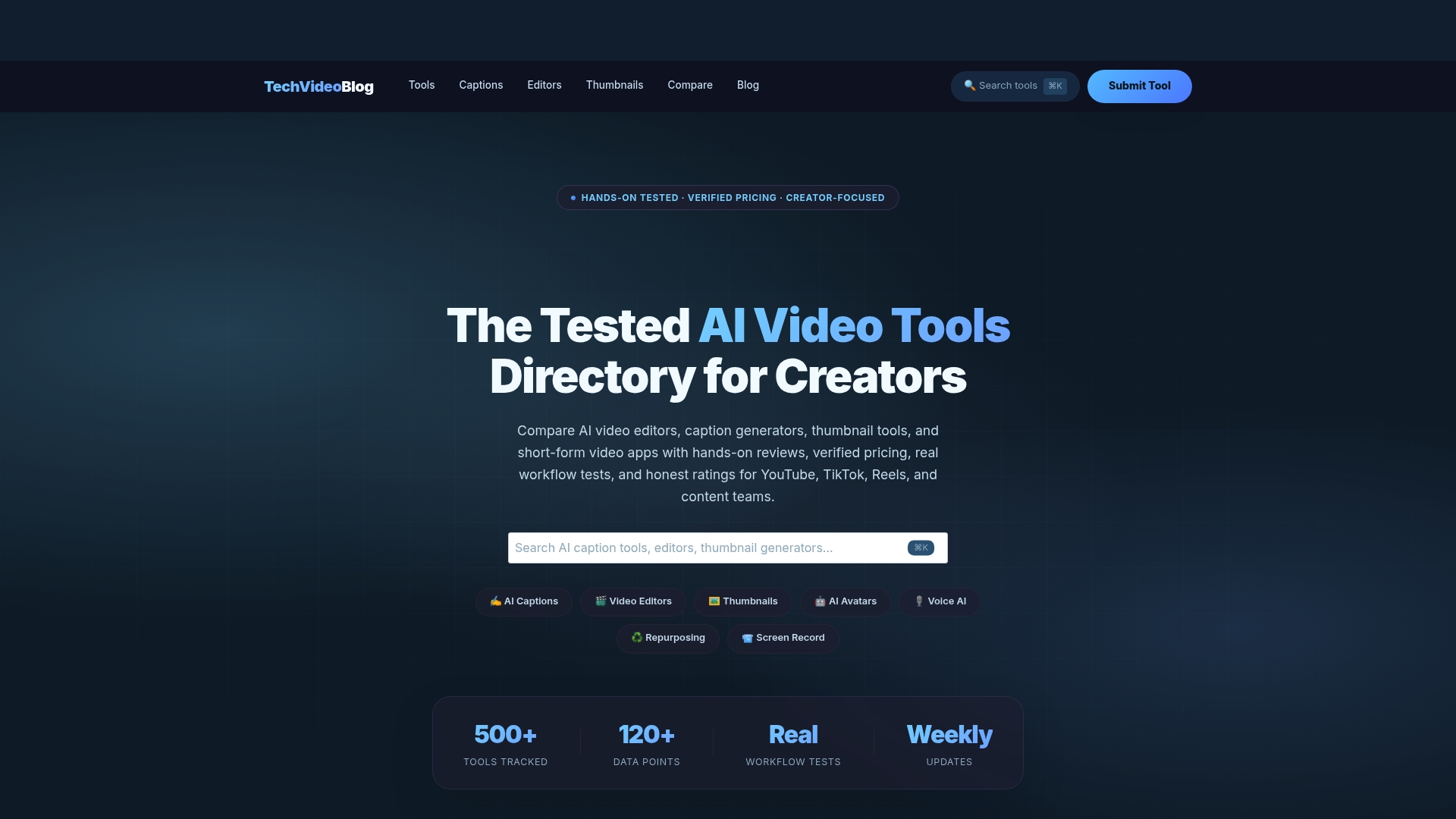
That’s the gap Techvideoblog closes. Instead of trusting marketing copy from tool vendors, the directory runs hands-on workflow tests and verifies pricing before publishing a review, so you can compare editors, caption generators, and thumbnail assistants on actual output quality rather than promises. For creators scaling Shorts production, the step-by-step AI workflow guide walks through building a Short from script to export using tested tools at each stage, and the volume-focused production guide covers how to sustain a testing cadence without burning out on manual editing. Some listings include affiliate or sponsored relationships, disclosed on each page, but rankings are built from workflow testing, not paid placement. Browse the YouTube Shorts tool directory to find the right tool for your next test cycle.
FAQ
How Do You Do SEO for YouTube Shorts?
Focus on matching search intent in your title and description, saying your keyword on camera, and keeping retention high through a strong first-second hook. YouTube’s own guidance confirms Shorts rank by performance and personalization, so metadata gets you discovered while retention keeps you recommended.
How Many Views Do You Need on Shorts to Earn $10,000?
There’s no fixed view count because payouts depend on your share of the Creator Pool, not a flat rate per view. Creators keep 45% of allocated Shorts ad revenue, and that share shifts based on total engaged views across the platform each month, so the exact view count needed varies. The Shorts monetization breakdown covers how the pool math works in more detail.
How Much Does YouTube Pay Per 1,000 Views on Shorts?
There’s no fixed rate per view for Shorts. Payouts come from a shared Creator Pool distributed based on engaged views, and creators must first accept the Shorts Monetization Module since views earned before acceptance don’t count toward revenue sharing.
What Is the 80/20 Rule Applied to Shorts SEO?
There’s no official YouTube version of an 80/20 rule for Shorts. If you’re applying the general Pareto principle to content strategy, it would mean roughly 20% of your formats or topics likely drive 80% of your views, which is exactly what the comparative testing loop in this guide is designed to identify.
Does Posting More Shorts Hurt Long-Form Video Performance?
No. YouTube confirms that Shorts performance doesn’t negatively affect long-form recommendations, so testing a Shorts strategy carries little risk to your existing long-form channel as long as each format still delivers on its own promise.