
The strongest HeyGen alternatives in 2026 are Synthesia for enterprise L&D, Arcade for software product demos, Creatify for high-volume ad creative, D-ID for developer API integrations, and InVideo for teams that want a free tier to test before committing. If your only frustration with HeyGen is a watermark on the free plan, upgrading HeyGen directly is faster than migrating workflows. But if you need SCORM exports, branching quizzes, URL-to-video automation, or a mature SDK, the right replacement depends entirely on the output type you produce.
Quick picks by use case:
- Enterprise L&D and compliance training: Synthesia — SCORM/LMS integrations, 140+ languages, enterprise SSO, and governance controls built in from day one.
- Software product demos and walkthroughs: Arcade — screen-first storytelling via Creator Studio; no talking head required.
- High-volume UGC-style ads: Creatify — URL-to-video, batch exports, and direct ad-platform connections for performance marketers.
- Developer and API embedding: D-ID — mature REST API and photo-to-video SDK for teams building avatar experiences into their own products.
- Structured e-learning with branching: Colossyan — in-video quizzes, branching scenarios, and SCORM export without the enterprise price tag of Synthesia.
- Free-tier testing: InVideo — template library, AI features, and a freemium tier that lets you validate output quality before paying.
Do not switch tools if your only complaint is render speed on a single project. Run a two-week pilot first, verify credit math, and confirm trial export rights before committing to any new platform.
Table of Contents
- How do the top HeyGen alternatives compare at a glance?
- Which HeyGen alternative is right for your specific workflow?
- How do you pick the right HeyGen alternative for your team?
- How Techvideoblog evaluated these platforms
- Key Takeaways
- The AI video tool market is specializing faster than most teams realize
- Techvideoblog’s directory helps you run a faster, smarter pilot
- Sources and where to verify live specs and pricing
How do the top HeyGen alternatives compare at a glance?
| Tool | Best For | Pricing (starter) | Free Tier / Trial | Custom Avatar | Avatar Realism & Lip Sync | Languages & Voices | Editing & Timeline | Integrations / API / LMS | Render Speed | Enterprise Features |
|---|---|---|---|---|---|---|---|---|---|---|
| Synthesia | Enterprise L&D, governance | ~$29/mo (Starter) | Free trial (no export) | Yes (photo → avatar) | High | 140+ languages | Basic timeline | SCORM, LMS, SSO, API | Fast | SSO, compliance, analytics |
| Veed | Social teams, repurposing | ~$18/mo | Free tier (watermark) | Limited | Medium | 50+ | Full timeline, captions | Zapier, social exports | Fast | Team workspaces |
| Runway | Creative / generative video | ~$15/mo | Free tier (limited credits) | No (generative) | N/A | Limited | Advanced generative | API | Medium | Limited |
| D-ID | Developer API embedding | ~$6/mo (Lite) | Free trial (20 credits) | Yes (photo → avatar) | Medium-High | 100+ | Minimal | REST API, SDK | Fast | Enterprise plan available |
| Elai (Elai.io) | Doc/deck-to-training video | ~$29/mo | Free trial | Yes | Medium-High | 70+ | Basic | SCORM, API | Fast | Team collaboration |
| Colossyan | Structured e-learning | ~$27/mo | Free trial | Yes | High | 70+ | Basic + branching | SCORM, LMS | Fast | SSO, compliance |
| Arcade | B2B SaaS product demos | ~$32/mo | Free tier | No | N/A (screen-first) | N/A | Screen capture + annotations | Embed, share links | Very fast | Team spaces |
| Creatify | Performance ad creative | ~$39/mo | Free trial | Limited | Medium | 29+ | Batch editor | Ad platform exports | Fast | Agency seats |
| AI Studios | Multi-avatar scene control | ~$30/mo | Free trial | Yes | High | 80+ | Scene composer | API | Medium | Enterprise plan |
| DeepBrain AI | Broadcast-style presenters | ~$30/mo | Free trial | Yes | Very high | 80+ | Basic | API | Medium | Enterprise plan |
| Puppydog.io | Fast short-form social clips | Freemium | Free tier | Limited | Medium | Limited | Minimal | Limited | Very fast | None |
| Pictory | Long-form repurposing | ~$19/mo | Free trial (3 videos) | No | N/A | Limited | Auto-caption, clip | Zapier | Fast | Team plan |
| InVideo | Template-based social video | Free / ~$20/mo | Free tier (watermark) | Limited | Medium | 50+ | Template editor | Limited | Fast | Business plan |
Pricing note: Most starter tiers listed above are billed annually. Monthly billing typically runs 20–40% higher. Credit systems vary significantly: some platforms count “generative credits” separately from rendered video minutes, and many low-cost tiers do not roll over unused credits. Always calculate your expected monthly rendered minutes before choosing a plan.
Legend: “Custom Avatar” = ability to create a personal avatar from a photo or short video clip. “Editing & Timeline” = whether the platform includes a multi-track or template-based editor beyond basic script-to-video. “Enterprise Features” = SSO, data retention controls, and admin governance.
Statistic to know: Multiple roundups consistently rank Synthesia as the closest like-for-like HeyGen replacement for enterprise and L&D use cases, citing its 140+ language support, SCORM export, and governance controls as the primary differentiators.
Which HeyGen alternative is right for your specific workflow?
The AI video market is fragmenting into verticals, and the tools below reflect that split clearly. Picking by avatar “cool factor” is the fastest way to end up with the wrong platform. Here is what each tool actually does well.

Synthesia
Synthesia is the most direct enterprise replacement for HeyGen. It covers 140+ languages, supports SCORM and xAPI exports for LMS delivery, and includes SSO plus admin governance controls that L&D teams at larger organizations require. The avatar quality is high, and the platform’s compliance posture is documented. The tradeoff: the editing environment is script-focused and not built for heavy timeline work. If you need to repurpose existing footage or add b-roll, you will need a second tool. See the Synthesia vs. HeyGen breakdown for a side-by-side on governance features.
Pros: 140+ languages, SCORM/LMS/SSO, strong governance, high avatar realism
Cons: Limited timeline editing, premium pricing for full enterprise features
Pricing snapshot: Starter at ~$29/mo (annual); enterprise pricing on request
Best for: Enterprise L&D, compliance training, multilingual rollouts
Veed
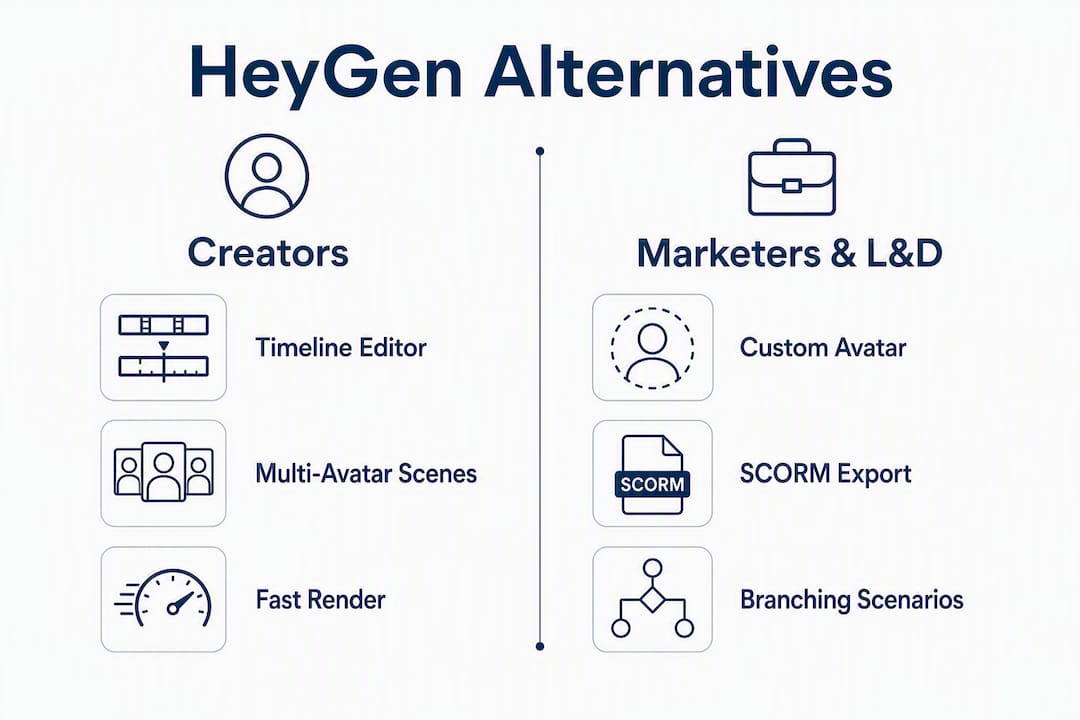
Veed leads with its timeline editor. Where most avatar platforms give you a script-to-video pipeline, Veed gives you a full editing environment with built-in captioning, social-format exports, and AI avatar features layered on top. Solo creators and lean social teams will find this combination reduces the need for a separate editor. Avatar realism sits at a medium tier compared to Synthesia or DeepBrain AI, but for short-form social content that tradeoff rarely matters. Solo creators and small marketing teams increasingly prefer bundled workflows that combine editing, captioning, and avatar generation in one subscription.
Pros: Full timeline editor, strong captioning, social export formats
Cons: Avatar realism below enterprise-grade tools, free tier adds watermark
Pricing snapshot: Free tier available; paid plans from ~$18/mo (annual)
Best for: Social teams, content repurposing, short-form video production
Runway
Runway is not an avatar platform. It is a generative video production suite, and that distinction matters for how you evaluate it. If you need scripted talking-head content, Runway is the wrong tool. If you need generative b-roll, visual effects, or creative product visuals for demos, it is one of the strongest options available. The ScoutPilot roundup lists Runway Gen-3 alongside InVideo AI and Kaiber as non-avatar alternatives worth considering for production-focused workflows.
Pros: Advanced generative video, flexible media transforms, strong creative output
Cons: No scripted avatar pipeline, limited language/voice options, learning curve
Pricing snapshot: Free tier (limited credits); paid from ~$15/mo (annual)
Best for: Creative teams, generative product visuals, demo B-roll
D-ID
D-ID is built for developers first. Its REST API and SDK let teams embed photo-to-video avatar experiences directly into their own products, apps, or platforms. The talking-head quality is solid, and the photo-to-avatar pipeline is one of the more mature in the market. The platform’s editing environment is minimal by design. If you are not integrating via API, you are not using D-ID for its primary strength. The HeyGen vs. D-ID comparison covers the API depth in more detail.
Pros: Mature REST API and SDK, photo-to-video pipeline, 100+ languages
Cons: Minimal built-in editor, not optimized for non-developer workflows
Pricing snapshot: Lite plan from ~$6/mo; enterprise pricing available
Best for: Developers embedding avatar video into products or apps
Elai (Elai.io)
Elai’s standout feature is document-to-video automation. You can feed it a PPTX, a PDF, or a URL and it will generate a structured video with an avatar presenter. For teams converting training documentation or product decks into video without a dedicated video producer, that workflow is genuinely faster than any script-first platform. SCORM export is available, which makes it viable for LMS delivery. Render speed is fast.
Pros: PPTX/PDF/URL-to-video automation, SCORM export, fast renders
Cons: Avatar realism is medium-tier, limited timeline editing
Pricing snapshot: Free trial available; paid from ~$29/mo (annual)
Best for: Teams converting documentation or slide decks into training videos
Pro Tip: If your primary output is training content, match your vendor category before comparing features. Elai and Colossyan are purpose-built for L&D automation; Creatify and Puppydog.io are built for ad speed. Mixing those categories leads to workflow friction that no feature list will warn you about.
Colossyan
Colossyan targets structured e-learning more directly than any other platform on this list. Branching scenarios, in-video quizzes, and SCORM export are native features, not add-ons. For compliance training or onboarding flows where learner completion tracking matters, Colossyan covers the governance gap that many avatar tools leave open. Avatar quality is high, and the platform supports 70+ languages. Enterprise teams should test for SCORM export, completion analytics, and SSO early in any L&D platform evaluation.
Pros: Branching scenarios, in-video quizzes, SCORM/LMS, 70+ languages
Cons: Less flexible for non-training use cases, limited generative features
Pricing snapshot: Free trial; paid from ~$27/mo (annual)
Best for: Structured e-learning, compliance training, branching course content
Arcade
Arcade solves a different problem than every other tool on this list. For B2B SaaS teams, the most effective product demo is not a talking-head avatar explaining features. It is the actual software interface, annotated and guided. Arcade’s Creator Studio is built for exactly that: screen-first storytelling with hotspots, annotations, and guided flows. If your demo workflow currently involves recording your screen and then adding a voiceover avatar, Arcade replaces that entire pipeline with a cleaner output. For product demo and software walkthrough use cases, screen-native tools consistently outperform talking-head avatars for viewer engagement.
Pros: Screen-first demo creation, Creator Studio, fast embed and share
Cons: Not an avatar platform, no scripted presenter pipeline
Pricing snapshot: Free tier available; paid from ~$32/mo (annual)
Best for: B2B SaaS product demos, software walkthroughs, interactive guides
Creatify
Creatify is purpose-built for performance marketing at volume. The URL-to-video feature pulls product details from a URL and generates ad-ready video in minutes. Batch export lets you produce multiple ad variants simultaneously, and direct connections to ad platforms reduce the steps between creation and campaign launch. Avatar realism is medium-tier, but for UGC-style ads that is often a feature rather than a limitation. Agency teams running high-volume creative testing will find the workflow faster than any general-purpose avatar tool.
Pros: URL-to-video, batch production, ad-platform exports, fast iteration
Cons: Limited avatar realism for premium brand content, 29+ languages only
Pricing snapshot: Free trial; paid from ~$39/mo (annual)
Best for: Performance marketers, UGC-style ad production, agency batch workflows
AI Studios
AI Studios offers more manual control over avatar scenes than most platforms. You can choreograph gestures, position multiple avatars in a single scene, and compose complex presenter setups that go beyond a single talking head. For teams producing structured corporate communications or multi-presenter training content, that granularity is useful. Render speed is medium, and the interface has a steeper learning curve than script-first tools.
Pros: Manual gesture control, multi-avatar scenes, 80+ languages
Cons: Medium render speed, more complex interface
Pricing snapshot: Free trial; paid from ~$30/mo (annual)
Best for: Multi-avatar scene composition, complex corporate video
DeepBrain AI
DeepBrain AI produces the most broadcast-quality avatar output on this list. The presenters look and move like news anchors, which makes the platform a natural fit for media teams, internal communications that need a polished on-camera feel, or any use case where avatar realism is the primary requirement. The editing environment is basic, so plan for post-production if you need complex timelines.
Pros: Very high avatar realism, broadcast-style output, 80+ languages
Cons: Basic editing, premium pricing for highest-quality tiers
Pricing snapshot: Free trial; paid from ~$30/mo (annual)
Best for: Media teams, broadcast-style presenter content, high-realism corporate video
Puppydog.io
Puppydog.io is the lightest tool on this list. The workflow is fast, the output is short-form, and the platform is aimed at creators who need social clips quickly rather than enterprise-grade governance. No SSO, no SCORM, no branching. For a solo creator testing avatar-based short-form content without a large budget, it is worth a free-tier test. Do not evaluate it against Synthesia or Colossyan on feature depth.
Best for: Fast short-form social clips, solo creators, low-budget testing
Pictory
Pictory’s core strength is repurposing. Feed it a long-form video, a blog post, or a transcript, and it extracts short clips with automated captions. There is no avatar pipeline. For content teams that produce long-form video and need a systematic way to generate social assets from it, Pictory reduces that workflow to minutes. The editing-forward all-in-one trend among lean marketing teams makes Pictory a natural fit alongside Veed and InVideo for repurposing-first workflows.
Pros: Strong repurposing, auto-captioning, fast clip extraction
Cons: No avatar features, limited language support
Pricing snapshot: Free trial (3 videos); paid from ~$19/mo (annual)
Best for: Content repurposing, long-form to short-form social asset production
InVideo
InVideo leads with templates and an editor-first workflow. The freemium tier lets you build and export videos before paying, which makes it the lowest-friction entry point for teams that want to validate output quality. AI features include script generation and auto-editing. Avatar capabilities are limited compared to dedicated avatar platforms, but for template-based social video production the tool covers most needs. The Joute tested roundup lists InVideo among the freemium options worth trialing for budget-conscious teams.
Pros: Freemium tier, large template library, editor-first workflow
Cons: Limited avatar realism, watermark on free tier
Pricing snapshot: Free tier available; paid from ~$20/mo (annual)
Best for: Template-based social video, teams testing before committing to a paid plan
How do you pick the right HeyGen alternative for your team?
The single most important decision you make before comparing any vendor is naming the primary output type you actually need to produce. Scripted avatar video for training, screen-native software demos, batch ad creative, and interactive agent experiences are four different jobs. Matching workflow type to vendor category is the most common mistake practitioners make when evaluating AI video platforms.

Start with output type, then work through these checkpoints in order.
Output type and volume math. Define whether you need scripted avatar video, screen-capture demos, generative creative, or repurposed long-form content. Then estimate your monthly rendered minutes. Most platforms price by credits or minutes, and base monthly price alone is misleading without knowing how many credits your actual workload consumes and whether unused credits expire at month end.
LMS and API requirements. If you are delivering training content, confirm SCORM or xAPI export before shortlisting any tool. Not all platforms that claim “LMS support” export in a format your LMS actually accepts. If you are building an embedded avatar experience, confirm the API has the endpoints and rate limits your engineering team needs.
Integrations and workflow fit. Check whether the platform connects to the tools your team already uses: your CMS, ad platform, project management system, or DAM. A tool that requires manual file export and re-upload for every video adds friction that compounds at scale.
Compliance, SSO, and data retention. For enterprise teams, especially in regulated industries, confirm SSO support, data residency options, and the vendor’s data retention policy before piloting. These are not features you can retrofit after signing a contract.
Commercial licensing for ads. If you plan to use AI-generated avatar video in paid advertising, verify the platform’s commercial licensing terms explicitly. Some platforms restrict avatar likeness use in ads or require an upgraded license tier.
Vendor questions worth asking directly. Ask every shortlisted vendor: How are credits counted, and do they roll over? What does the trial tier allow you to export? Is SCORM export available on the plan you are evaluating? What is the SLA for render speed at your expected volume? Where is video data stored, and how long is it retained?
Red flags to watch for. Opaque credit models with no usage calculator, trial tiers that prevent download or export, missing SSO for a team of 50+, and language support that does not cover your audience are all signals to pause. A vendor that cannot answer the data retention question clearly is a governance risk for any L&D deployment.
Two-week pilot plan. Pick two to three tools from your shortlist. Allocate one week to produce a representative sample of your actual output type on each platform. In week two, calculate the true cost per finished minute at your expected monthly volume, test the LMS or API integration end-to-end, and confirm export rights on the trial tier. That two-week test costs less than one month of a wrong annual subscription.
How Techvideoblog evaluated these platforms
Every platform in this article was evaluated against a consistent set of criteria: script-to-video render quality, URL and PPTX ingestion where the feature exists, API call behavior where documentation is public, LMS export fidelity, and team-collaboration workflow. Pricing was verified against each vendor’s public pricing page. Trial limitations, watermark behavior, and credit expiry policies were checked directly.
The evaluation metrics used, and why each matters:
- Avatar realism and lip sync: Determines whether the output is credible for your audience. High realism matters more for external-facing content than for internal training.
- Render speed: Affects iteration speed. Slow renders on a batch workflow add hours per week.
- Export fidelity: Whether the exported file matches the in-platform preview, and whether SCORM packages load correctly in a target LMS.
- Credit math: The true cost per finished minute, accounting for credit type, volume, and expiry rules.
- Enterprise governance: SSO, admin controls, data retention, and compliance documentation.
- Integrations: Whether the platform connects to the tools your team already uses without manual workarounds.
Pricing and feature data were collected in mid-2026. Vendor pricing changes frequently, and trial conditions can shift without notice.
Readers should verify live pricing, trial export rights, and LMS compatibility directly with each vendor before purchasing. The Techvideoblog AI video tools directory is updated regularly with verified pricing notes and hands-on workflow observations.
Key Takeaways
Synthesia is the strongest like-for-like HeyGen replacement for enterprise L&D, while Arcade, Creatify, and D-ID each win their own narrow workflow category.
| Point | Details |
|---|---|
| Match tool to output type first | Define your primary output (training, demo, ad, API) before comparing any features or pricing. |
| Credit math beats base price | Calculate monthly rendered minutes and check credit expiry rules to find the true cost per finished video. |
| Test trial export rights early | Confirm what you can actually export on a trial tier before investing time in a platform pilot. |
| Governance gaps can block L&D rollouts | Test SCORM export, SSO, and completion analytics in week one of any enterprise L&D pilot. |
| Techvideoblog directory | Use the Techvideoblog AI video tools directory to build a verified 2–3 tool shortlist with current pricing and hands-on notes. |
The AI video tool market is specializing faster than most teams realize
The clearest pattern across all of these platforms is vertical specialization. A year ago, most AI video tools tried to serve every use case. Now, the best tools are optimized for a single job: Colossyan for branching e-learning, Creatify for ad batch production, Arcade for software demos, D-ID for API embedding. That is not a marketing positioning choice. It shows up in the feature depth, the pricing model, and the workflow design.
The practical implication: if you evaluate these tools as interchangeable avatar generators, you will consistently pick the wrong one. The team that needs SCORM exports and SSO will be frustrated by Creatify’s ad-first interface. The performance marketer who needs 50 ad variants per week will find Synthesia’s governance-heavy workflow slow and expensive for that job.
Two things I consistently see teams get wrong in pilots. First, they compare base monthly price without running the credit math for their actual volume. A platform that looks cheaper at $20/mo can cost three times more than a $40/mo competitor once you account for credit limits and expiry. Second, they skip the trial export test. Several platforms restrict what you can download on a free or trial tier, which means you cannot validate output quality for your actual use case without paying first. Both of those mistakes are avoidable with a structured two-week pilot.
One forward-looking note: the tools most worth re-evaluating in the next 12 months are those adding interactive agent features, real-time avatar rendering, and voice cloning with custom speaker models. If your use case shifts from scripted video to interactive or real-time avatar experiences, your current shortlist will need a full reassessment.
Techvideoblog’s directory helps you run a faster, smarter pilot
Sorting through 14 platforms with different credit models, trial restrictions, and feature sets takes time most teams do not have. Techvideoblog’s AI video tools directory cuts that research time by giving you verified pricing, hands-on workflow notes, and use-case filters in one place. Instead of visiting 14 vendor pages and reading marketing copy, you can filter by output type, confirm trial export rights, and build a two-to-three tool shortlist in under 20 minutes.
The directory also covers editing-forward tools for teams that need timeline editing alongside avatar features, and product demo specialists for SaaS teams evaluating screen-native alternatives to talking-head video. If you want a consolidated workflow that bundles avatar generation with editing, captioning, and b-roll in a single tool, the Kudoflix video editor is worth adding to your pilot list alongside the platforms above.
Start with the directory, build your shortlist, and run your two-week pilot with verified pricing in hand.
Sources and where to verify live specs and pricing
These are the primary sources used to research and verify the platforms in this article. Pricing and feature data change frequently. Confirm current plans directly with each vendor before purchasing, and verify commercial licensing terms before using AI-generated avatar video in paid advertising.
- Synthesia — HeyGen alternatives and competitors (company blog) — Hands-on vendor comparison; useful for enterprise L&D feature depth and Synthesia vs. HeyGen governance notes.
- Creatify — Best HeyGen alternatives — Ad-focused workflow comparison; useful for URL-to-video and batch export feature verification.
- HeyGen — Wikipedia — Company history, founding details, and HQ information for readers researching HeyGen’s background.
- G2 — HeyGen reviews — User reviews and verified ratings for HeyGen; useful for cross-referencing feature satisfaction data.
- G2 — Synthesia reviews — User reviews for Synthesia; cross-reference for enterprise L&D satisfaction signals.